State of the Telecommunications Sector in Georgia
Author O. Shatberashvili
The Article describes the current situation
and development trends in the sphere of telecommunications in Georgia.
Telecommunications
From the moment the country
gained its independence, no other sector in Georgia has witnessed development on such a
rapid scale as that of telecommunications. Moreover, the development has taken place
against the background of the decline of other sectors. This phenomenon can be ascribed to
the following factors: ·
the gaining of
independence and the transition to a market economy have lifted artificial restrictions
inherent in the USSR that were impeding the sector’s development, especially of
international communications; ·
the said period
coincided with a boom in the use of cellular mobile phones, the Internet and IP telephony
and the telecommunication sector as a whole throughout the world, which could not help but
affect Georgia also; ·
the
above-mentioned boom has served as a stimulus for attracting foreign investments in the
country's telecommunications sector, rendering it of priority significance compared to
other sectors. Market
economy has substantially settled in the telecommunications sector of the country after
carrying out of reforms. The sector became fragmented after demonopolization and
liberalization and private enterprises started operation on the market together with state
ones. The process is illustrated on the Fig. 9.1. Foreign
investments and credits played a significant role (Fig.9.2). The overall growth of the sector could
be characterized by the income of US$180 mln in 2001 compared to US$40 mln in 1996. Table 9.1
Density of Communications
|
Type
of communications
Telephone |
Mobile
phone |
Internet-linked
computers |
| Density
(number per 1000 inhabitants), % |
12 |
6.5 |
0.6
|
Local telephone
communications (PSTN)
Six operator companies function
in Georgia, with the largest being Georgian Elkavshiri (state-owned, 600 thou users) and
Akhali Kselebi (private, 100 thou users). Tbilisi has a capacity of 26 telephones/100
inhabitants. A relatively high level exists in the towns of Kutaisi, Batumi and Poti, in
comparison to rural areas where such level is extremely low.
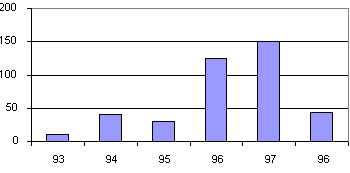
Fig. 9.1. Number of new telecommunication firms obtaining an operating license from the
Ministry of Communications
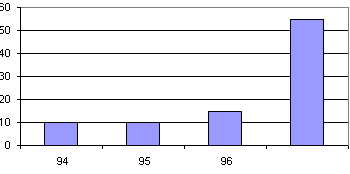
Fig. 9.2. Foreign investments and credits (US$ million)
Fig. 9.3. Cellular communications growth (number of subscribers, thou)
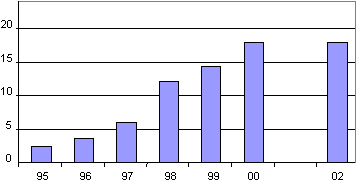
Fig. 9.4. Number of Internet service providers (ISPs)
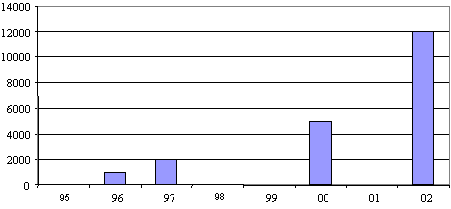
Fig. 9.5. Number of Internet-linked computers
The development of telephone networks in rural areas needs investments five times
exceeding those in urban areas. The most active company working on the issue is Infotell
introducing Swedish Ericsson technology.
The present situation has
been achieved as a result of the installation of electronic exchange stations carried out
by Turkish, Israeli, Korean and other foreign companies. At present both electronic (70%
of total capacity) and old-type crossbar (30%) exchanges are in operation. Some companies
provide free local calls charging only subscriber fees (US$1.5-2 per month), while others
offer 300 free minutes per month, at a rate of US$0.01 per minute for extra call-time
(plus the subscriber fee – US$1).
According to the density of registered telephones (12%) Georgia is considered among the
medium developed countries.
International
and trunk telephone communications
Fifteen interna­tional operators function in Georgia, with the
largest being Georgian Telecom, 51% of whose shares are still held by the State. Other
operators are private. Tariff with different operators is US$0.25 per minute when
communicating with the US, between US$0.30-0.35 per minute when communicating with Europe,
and US$0.25-0.35 per minute when communicating with the CIS countries. Sprint, AT & T,
MCI, SCOTTCO and Deutsche Telecom are the main partners of the interna­tional
communication operators. About 800 digital satellite lines connect Georgian operators to
the networks of these companies. In addition, international communications are provided by
a further four companies, making use of IP telephony for calls to the US and Europe. Their
prices fluctuate within US$0.90 per minute to US$0.40 per minute. Since 1998 international
calls have been carried out by means of electronic cards (priced at between 5 to 50 GEL)
purchased in advance. Fiber-optic
lines started to play growing role in the trunk communications. Total length of them is
446 km (10% of all trunk lines). This is mainly Georgian segment of TransAsia-Europe
fiber-optic line. New fiber-optic lines are under construction: Poti-Rize (Turkey) and
Poti-Varna (Bulgaria) segments of the above-mentioned line and also the line passing along
Armenia-Azerbaijan-Georgia Railways. Foptnet, Wanex and Georgian Railroad companies are
operators of these lines. Mobile (cellular)
telephony The first local
operator started operations in 1994. At present, three companies are in operation. This is
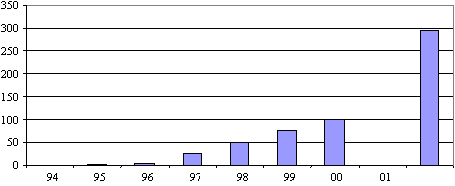
one of the fastest-growing sectors of the national economy. The total number of mobile
phones is 295 thou. The growth rate can be seen in Fig. 3. The largest company - MAGTI
(210 thou users) covers 95% of Georgian territory. Geocell has 80 thou users and covers
80% of the territory. Megacom with 5 thou users occupies the rest of the market. Two
operators use GSM 900/1800 technology and one uses AMPS 800.
The Internet
The first Internet
service provider (ISP) started operations in 1993. At present, 11 commercial and four
non-commercial providers are in operation. The number of users is estimated at
approximately 40 thou. The number of Internet-linked computers amounts to 12 thou in 2002
(5 thou in 2000). Despite this the Internet users' growth rate per 1000 inhabitants falls
behind a similar index for the world. Information resources on the Georgian Internet
sector include more than 2000 sites, according to the directory Georgia in InternetThe tariff for Internet access
fluctuates between the different providers, at between US$0.30 per hour to US$0.60 per
hour, dial-up mode for the speed 33 Kbit/sec.
Radio and television
Independent
television and FM radio stations have significantly increased in number of late. Where
only four local TV companies and two local channels were in operation before 1989, now
tens of the companies are involved in the preparation and distribution of television
broadcasts and 14 local TV channels are functioning.
Only one radio company broadcasting on three frequencies used to operate in Georgia. At
present, 15 FM radio stations operate in the country, and three of them are capable to
cover the whole territory of Georgia.
The most advanced TV and
radio companies operate through use of satellite communication and the Internet.
Also in operation are three subscriber television networks (two of them cable) with
encrypted signals.
Technological
development
In
addition to the gradual transition of telephone communication to electronic exchanges and
to satellite systems for international communica­tions and the introduction of IP
telephony, the most significant of the latest technological advances are the fiber-optic
ring connecting Tbilisi exchanges, the fiber-optic backbone linking eastern and western
Georgia, the relay line also linking eastern and western Georgia, and the announcement
made by Georgian Telecom concerning its mastering and introduction of the Ericsson’s
ISDN technology. E-commerce is making initial steps in a number of Georgian companies.
Regulatory environment and
future prospects
State
policy in the telecommu­nica­tions sector is being elaborated and pursued
by the Ministry of Transport and Communications. Other procedures for fixing and
regulating tariffs, also registering and licensing of operators, are carried out by the
independent Regulatory Commission. Specific matters within the
teleco­mmu­nications sector (e.g. Internet content, etc.) are also dealt
by the State Department of Informatization . Mention must
also be made of the Coordinating Council for the Development of Information and
Communication Technologies, which is presided over by the Georgian President. The
Council’s function, jointly with all the above-listed bodies, the academic community,
other concerned agencies and organizations, is to elaborate national policy in the
informa­tion sector, including telecommunications as an integral part.
At present the following Acts governing activities of the telecommunications sector
have been adopted by the Georgian Parliament:
·
The Law on
Communications and Post, dated 23 June, 1999;
·
The Law on the
Press and other Mass Information Media, dated 10 August 1991; ·
Georgian Law No.
686, dated 13 December 2000, "concerning amendments and supplements to certain legal
acts of Georgia” (including licensing in the field of communication). Another body playing a significant
part in the telecommunication sector develop­ment is the Ministry of State
Property Management. This Ministry is entrusted to manage the blocks of state owned shares
in telecommunication companies and thus plays a decisive role in the privatization of
these companies. Its purpose is to hold tenders for making the said companies private. In
the near future it plans to sell the state-owned shares in the two largest companies of
Georgian Telecom (65% of the international communications sector) and Georgian Elkavshiri
(60% of local telephone communications). Of utmost importance is the issue of
attracting foreign investments in the areas of the sector where the level of development
remains low: telephony in rural areas, the Internet, the ISDN technology expansion and
further introduction of fiber-optic lines. Taking into account that the telephone
installing level is less than half that of developed countries, that Internet development
is ten-times less than the world average, that telephone communication
develop­ment in rural areas is just in embryo, it can be concluded that the sector
has rather good prospects for growth.
Georgia in Internet, Techinformi, 2003
Informatization is a term that appeared at the end of the Soviet period,
meaning the process of putting information technologies and resources into public service